


Optimizing and Accelerating Medical Device Regulatory Approvals with AI and RWiD

Reading time /
6 min
Industry

.avif)
TL;DR
· AI and real-world imaging data are enabling more systematic, traceable, and evidence-driven regulatory submissions for medical devices.
· The FDA evaluates five properties of imaging datasets for 510(k) submissions: representativeness, traceability, independence, annotation quality, and documentation.
· Train/tune/test separation is a foundational requirement. Repeated evaluation against the same holdout constitutes data leakage and is a recurring deficiency in FDA feedback.
· The variable that most consistently determines submission readiness is not model performance. It is whether the validation dataset was sourced, documented, and locked to withstand regulatory scrutiny.
Introduction
Artificial intelligence (AI) and real-world imaging data(RWiD) are reshaping the regulatory approval process for medical devices. By enabling more systematic, traceable, and evidence-driven submissions, they address limitations that have historically slowed the path from device development to market authorization. AI supports automation of compliance functions and near-real-time signal detection. RWiD integrates evidence drawn from actual clinical practice into regulatory review, strengthening the case for device safety and effectiveness across diverse patient populations.
The FDA has responded to rapid AI adoption in healthcare by developing dedicated regulatory frameworks. In January 2021, the FDA published the “Artificial Intelligence/Machine Learning (AI/ML)-Based Software as a Medical Device (SaMD) Action Plan,” the first federal framework outlining a regulatory path for AI/ML-based SaMDs. A joint paper on guiding principles for safe and effective AI/ML medical devices followed later that year. In June2024, the FDA released guidance on transparency for machine learning-enabled medical devices. The FDA’s 2025 draft guidance on “Artificial Intelligence-Enabled Device Software Functions: Lifecycle Management and Marketing Submission Recommendations” further describes a risk management approach across the total product lifecycle. A consistent theme across these documents is that AI must provide documented value to patients, and that human oversight remains a requirement in clinical workflow.
What “Regulatory-Grade” Imaging Data Actually Means
The FDA does not issue a certification for “regulatory-grade” datasets. The standard is functional: data must be representative of the device’s intended use population, traceable to its acquisition source, independently validated, and documented with sufficient rigor to with stand regulatory review. For imaging AI submitted via 510(k), reviewers evaluate not just what data was used, but how it was collected, labeled, split, and governed.
In practice, five properties determine whether imaging data will support a 510(k) submission:
Data Source Options and Their Regulatory Tradeoffs
Companies pursuing 510(k) clearance for imaging AI draw from three primary data source types. Each carries distinct regulatory weight.
Multi-site clinical partnerships remain the strongest basis for validation evidence. Datasets collected directly from hospitals and health systems under data use agreements, IRB review, and HIPAA-compliant de-identification reflect real-world acquisition variability across scanner vendors, clinical protocols, and patient populations. The evidentiary advantage is generalizability: a model validated against consecutive patients from multiple institutions using different scanner manufacturers is materially harder to challenge than one validated on a curated single-center cohort.
Commercial imaging data providers with documented provenance, expert annotation pipelines, and licensing terms that explicitly permit regulatory submission use can compress timelines without sacrificing traceability. When evaluating a vendor, the operative questions are whether source hospitals are identified, whether annotation SOPs are auditable, and whether the license explicitly covers FDA submission use not just research or commercial AI development.
Public datasets (e.g., The Cancer Imaging Archive, NIH chest X-ray collections, RSNA challenge repositories) are appropriate for algorithm prototyping and benchmarking. They are rarely sufficient as primary validation evidence for a 510(k) because they frequently reflect historical acquisition protocols, limited institutional diversity, incomplete clinical metadata, and labeling processes that predate current annotation standards. Geographic concentration in public training cohorts is a documented limitation that restricts the generalizability of models trained on them.
The practical path for most programs: prototype with public data, train on multi-site clinical data, and reserve a fully independent external cohort (from institutions not involved in any development phase) for the locked performance evaluation submitted to FDA.
The Role of Real-World Imaging Data
The medical device regulatory landscape has adapted to include advanced digital health solutions and the rapid advancements in AI, particularly in imaging diagnostics. A fundamental driver of this shift is the expanding use of RWiD.
Accelerated Evidence Generation
Regulatory bodies are increasingly receptive to real-world data (RWD), particularly imaging data, to substantiate the safety, efficacy, and labeling of medical devices. Real-world imaging data, derived from actual patient care and sources such as clinical registries, can accelerate evidence generation and reduce the time and cost associated with traditional clinical trial methods.
Impact on Approval Timelines
The 510(k) and PMA pathways have seen growing use of RWD as supporting evidence. RWiD-supported submissions have been particularly concentrated in cardiovascular and radiology AI applications, where registry-based evidence provides a strong real-world clinical data foundation.
Impact on Generalizability of AI Models
Geographic concentration in training data limits the generalizability of AI models across diverse patient populations. Sourcing RWiD from multiple states and internationally produces training and validation data that better reflects the populations a deployed device will encounter. Diversity in training data correlates with more robust model performance across clinical settings.
Dataset Documentation and Structural Requirements for 510(k) Submission
Performance numbers alone do not constitute a regulatory evidence package. FDA reviewers evaluate the dataset itself its construction, governance, and the integrity of the train/test boundary as a primary indicator of submission quality.
Train, tune, and test separation is a foundational requirement. The locked test set must never be used during model development or selection. Repeated evaluation against the same holdout even informally constitutes data leakage and is a recurring deficiency in FDA feedback on AI submissions. The test set should be drawn from patient populations and sites not represented in the training corpus.
External validation from institutions not involved in any phase of development materially strengthens a submission. For imaging AI, this typically means sourcing final validation studies from geographically distinct health systems using different scanner configurations than those represented in the training set.
Documentation that reviewers expect:
Sample size has no FDA-mandated minimum. Appropriate size is determined by disease prevalence, endpoint type, expected model performance, and the statistical power required to support the specific claims being made. A narrow-indication triage tool may require fewer cases than a broadly applicable diagnostic classifier, provided the statistical justification is explicit and predefined.
Synthetic data can support augmentation and robustness testing for rare classes but should not replace real clinical data as the primary basis for clinical validation in a 510(k). Where synthetic data is used, its role and justification must be clearly described within the overall evidence package.
How AI Enhances and Optimizes the Regulatory Process
Automated Regulatory Technology
Regulatory authorities are developing AI tools to centralize screening data, identify risk signals, and assess submissions improving the quality and scope of oversight while enabling faster review cycles. These include compliance-checking frameworks and software that evaluates source code for defects, reducing the manual burden on both submitters and reviewers.
Adaptive and Iterative Change Management
The FDA has introduced Predetermined Change Control Plans(PCCPs) in its updated guidance. PCCPs allow manufacturers to document anticipated algorithm updates and the data and testing protocols that govern them, enabling regulatory bodies to authorize iterative changes without restarting the full review process for each update. The data implications a resignificant: PCCPs require that the datasets and performance benchmarks governing future changes be specified at the time of initial submission.
Real-World Use Cases of AI and RWiD Driving Faster FDA Approvals
AI for Radiology Triage
An AI-based computer-aided detection tool designed to automatically identify fractures and imaging anomalies used large-scale, multi-site real-world imaging datasets for training and validation. The resulting evidence demonstrated clinical utility across diverse acquisition environments, supporting FDA clearance on an accelerated timeline.
AI-Powered Imaging Companion
An AI platform assisting radiologists with quantitative and qualitative analysis of chest CTs demonstrated reliability and generalizability through use of diverse, real-world imaging repositories sourced across multiple institutions and scanner types. This evidence structure streamlined the FDA’s510(k) clearance review and reduced time to authorization.
Wearable Device with ECG and Arrhythmia Monitoring
A wearable health technology incorporating ECG and atrial fibrillation history analysis drew on large real-world monitoring datasets to establish effectiveness across heterogeneous patient populations. The breadth and clinical representativeness of this evidence accelerated regulatory review and enabled authorization of continuous monitoring features outside clinical settings.
AI for Early Sepsis Risk Prediction
AI-based predictive software for sepsis risk assess mentintegrates imaging data with real-world hospital EHRs. By validating performance across diverse hospital datasets (covering different EHR systems,patient acuity distributions, and clinical protocols) the solution obtained FDA marketing authorization more efficiently than traditional clinical trialapproaches would have.
How Segmed Supports FDA 510(k) Data Requirements
Segmed’s imaging network spans healthcare partner sites across all 50 U.S. states and five continents, covering diverse scanner vendors, acquisition protocols, and patient populations. This scale addresses themulti-site, multi-vendor representativeness that FDA reviewers evaluate when assessing generalizability.
For 510(k) submissions specifically, Segmed provides:
Regulatory-grade validation cohorts: Curated for specific modalities, indications, and demographic distributions, with full provenance documentation suitable for inclusion in a Design History File.
Independent external validation datasets: Studies sourced from institutions independent of a customer’s development environment, addressing the locked test set requirement without requiring new clinical partnerships.
Openda: A self-service data platform enabling cohort search, patient-level longitudinal study navigation, and collaboration across development and validation teams, with SNOMED-based search and support for complex modalities including PET/CT and PET/MR.
Incognito: A HIPAA Safe Harbor–compliant de-identification tool for DICOM files and associated text reports, supporting the de-identification documentation requirements of a regulatory submission.
Custom curation: Expert-curated cohorts for specific clinical indications, with annotation services, inter-reader agreement analysis, and dataset documentation packages aligned to FDA reviewers expectations.
The compliance infrastructure (SOC 2 Type II, ISO 27001, and HIPAA) covers the data governance documentation that submissions require. Segmed’s platform links imaging data with EHRs, claims, and patient outcomes via advanced tokenization, providing a comprehensive view of device safety and performance in real-world clinical settings, for post-market surveillance and label extension submissions.
Connect with Segmed to discuss how our regulatory-grade imaging datasets and data governance infrastructure can support your 510(k) submission strategy →
Acquisition Roadmap: From Data Strategy to 510(k) Submission
A staged approach to imaging data acquisition aligns development efficiency with regulatory defensibility:
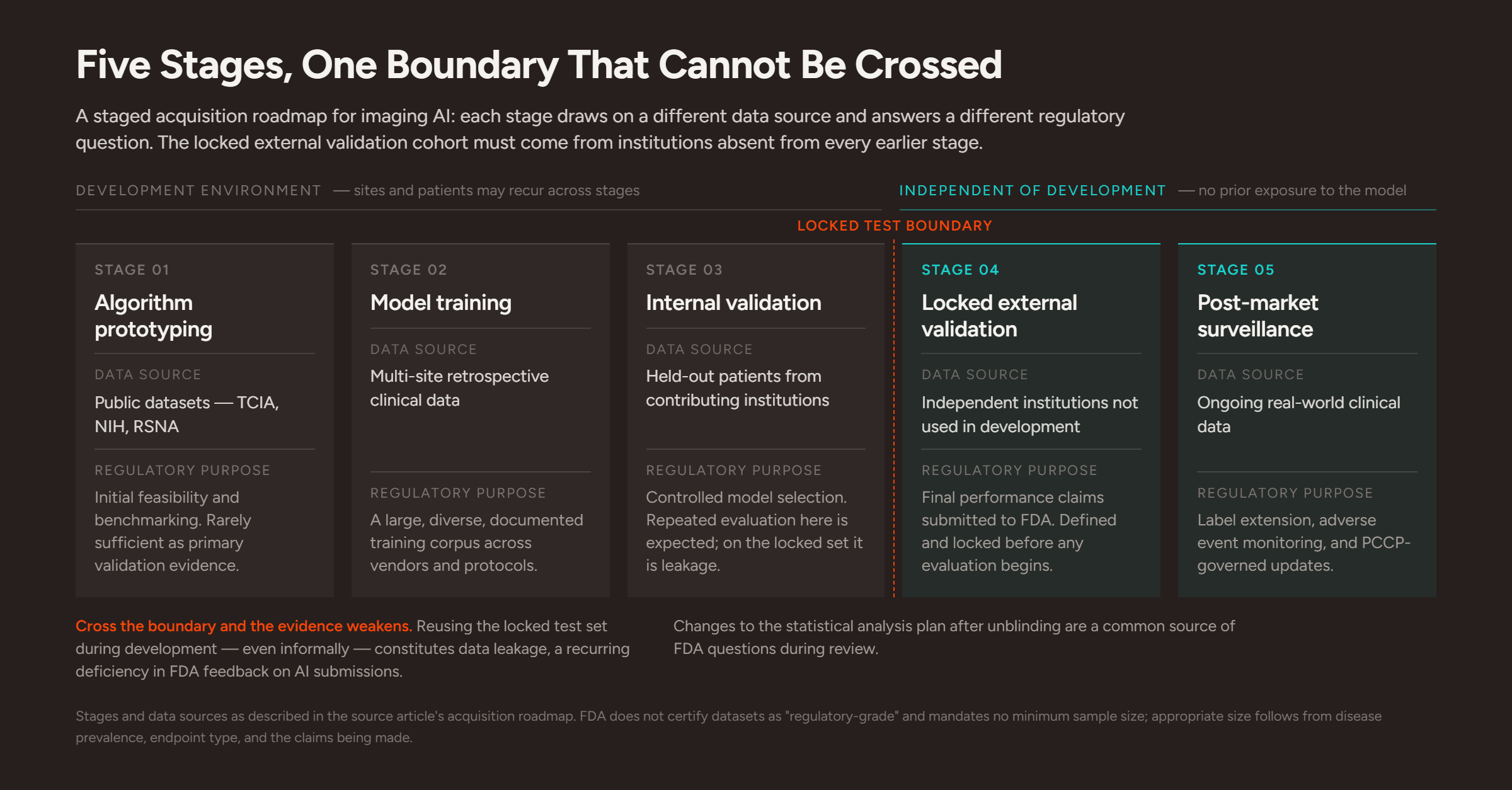
The locked external validation dataset should be defined inclusion criteria, sample size rationale, statistical analysis plan before any model evaluation begins on it. Changes to the analysis plan after unblinding are a common source of FDA questions during review.
For teams building imaging AI on a commercial timeline, the variable that most consistently determines submission readiness is not model performance. It is whether the validation dataset was sourced, documented, and locked in a way that can withstand structured regulatory scrutiny.
Frequently Asked Questions – F.A.Q.
What does “regulatory-grade” imaging data mean for a 510(k) submission?
The FDA does not certify datasets as regulatory-grade. The standard is functional: data must be representative of the intended use population, traceable to its acquisition source, independently validated, and documented with sufficient rigor to withstand regulatory review. FDA reviewers evaluate not just what data was used, but how it was collected, labeled, split, and governed.
What are the five properties the FDA evaluates in imaging datasets?
The five properties are representativeness, traceability, independence, annotation quality, and documentation. Representativeness requires that demographics, disease prevalence, scanner vendors, and acquisition protocols reflect the clinical environment. Independence requires that the final test set come from populations and institutions not used during training or model selection.
What is a Predetermined Change Control Plan (PCCP)?
A PCCP is an FDA mechanism that allows manufacturers to document anticipated algorithm updates and the data and testing protocols that will govern them. This enables regulatory bodies to authorize iterative changes without restarting the full review process for each update. PCCPs require that the datasets and performance benchmarks governing future changes be specified at the time of initial submission.
Can public datasets be used for 510(k) validation?
Public datasets such as The Cancer Imaging Archive, NIH chest X-ray collections, and RSNA challenge repositories are appropriate for algorithm prototyping and benchmarking. They are rarely sufficient as primary validation evidence for a 510(k). They frequently reflect historical acquisition protocols, limited institutional diversity, and incomplete clinical metadata.
What is data leakage and why does the FDA flag it?
Data leakage occurs when the locked test set is used during model development or selection even informally. Repeated evaluation against the same holdout allows models to overfit to the test data, producing inflated performance estimates. This is a recurring deficiency in FDA feedback on AI submissions. The test set must come from patient populations and sites not represented in the training corpus.
Does the FDA require a minimum sample size for imaging AI submissions?
The FDA does not mandate a minimum sample size. Appropriate size is determined by disease prevalence, endpoint type, expected model performance, and the statistical power required to support the specific claims being made. A narrow-indication triage tool may require fewer cases than abroadly applicable diagnostic classifier, provided the statistical justification is explicit and predefined.
Can synthetic data be used in a 510(k) submission?
Synthetic data can support augmentation and robustness testing for rare classes. It should not replace real clinical data as the primary basis for clinical validation in a 510(k). Where synthetic data is used, its role and justification must be clearly described within the overall evidence package.
References
1. U.S. Food and Drug Administration. Artificial intelligence/machine learning (AI/ML)-based software as a medical device (SaMD) action plan [Internet]. Silver Spring (MD): FDA; 2021 Jan 12 [cited 2026 Jul 3]. Available from: https://www.fda.gov/media/145022/download
2. U.S. Food and Drug Administration, Health Canada, Medicines and Healthcare Products Regulatory Agency. Good machine learning practice for medical device development: guiding principles [Internet]. Silver Spring (MD): FDA; 2021 Oct 27 [cited 2026 Jul 3]. Available from: https://www.fda.gov/medical-devices/software-medical-device-samd/good-machine-learning-practice-medical-device-development-guiding-principles
3. U.S. Food and Drug Administration, Health Canada, Medicines and Healthcare Products Regulatory Agency. Transparency for machine learning-enabled medical devices: guiding principles [Internet]. Silver Spring (MD): FDA; 2024 Jun 13 [cited 2026 Jul 3]. Available from: https://www.fda.gov/medical-devices/software-medical-device-samd/transparency-machine-learning-enabled-medical-devices-guiding-principles
4. U.S. Food and Drug Administration. Artificial intelligence-enabled device software functions: lifecycle management and marketing submission recommendations [Draft Guidance] [Internet]. Silver Spring (MD): FDA; 2025 Jan 7 [cited 2026 Jul 3]. Available from: https://www.fda.gov/media/184856/download
Related sources
Fit-for-purpose real-world imaging data: the difference between more data and better data
Multimodal data pipelines: the new gold standard in pharma research