


Is It Time for Every Physician to Have an AI Diagnostic Buddy?

Reading time /
5 min
TL;DR
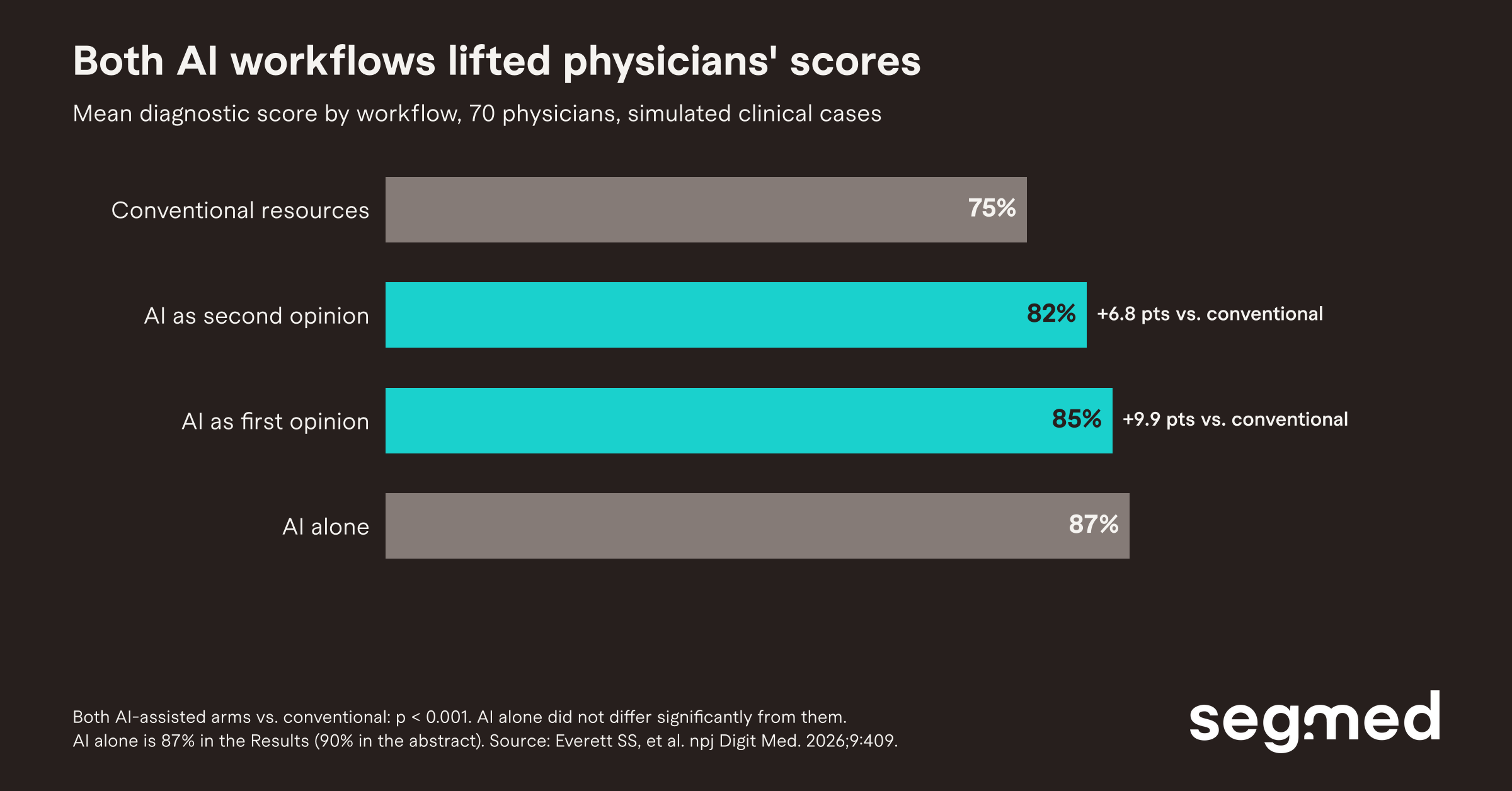
- In a randomized trial of 70 physicians, collaborating with artificial intelligence (AI) raised diagnostic scores to 85% and 82%, versus 75% with conventional resources.1
- Timing mattered. AI as a first opinion scored 8.9 percentage points higher than AI as a second opinion on clinically actionable decisions.
- When AI saw the physician's assessment first, it repeated all three initial diagnoses in 48% of cases, versus 3% when it answered independently.
- AI sometimes made decisions worse, and the trial used simulated cases. Learning how to work with AI may be as important as the tool itself.
Introduction
If you are a practicing physician and an AI enthusiast, you have probably tried to bring a large language model into your routine. At first, it is pure heaven. Improved documentation. Quick searches for medical updates. Everything seems faster, easier, and more efficient.
You ask AI to review a difficult case, suggest alternative diagnoses, or summarize the latest evidence. But then you find yourself checking references, questioning recommendations, and refining prompts. After a few cases, you realize the whole process takes substantially more time. Even worse, it adds to your cognitive workload. You feel like you have gone straight from heaven back down to Earth.
Then comes the inevitable question: is it worth it?
What Did the Trial Test?
A recent randomized controlled trial by Everett et al., published in npj Digital Medicine, explored part of this dilemma. The study included 70 physicians who evaluated simulated clinical cases. The authors looked at different ways clinicians could interact with AI, from diagnostic assessments to commentary and recommendations.
But there was an important difference from simply asking a general chatbot for a second opinion. The researchers built a custom GPT-4 system designed for collaboration between clinicians and AI. Both could evaluate a case independently. The system then compared their conclusions, highlighting agreements, disagreements, and opportunities for further reasoning. The study evaluated a structured collaborative workflow, not the conventional use of a chatbot.
They also tested two workflows: AI as a first opinion, preceding the clinician, and AI as a second opinion, following the clinician.
Did the AI Buddy Help?
Both workflows improved diagnostic performance compared with conventional resources. With AI as a first opinion, physicians scored 85% (mean difference 9.9 percentage points, 95% confidence interval (CI) 4.7 to 15.0). With AI as a second opinion, they scored 82% (mean difference 6.8 percentage points, 95% CI 4.0 to 9.6). With conventional resources, they scored 75%.
Performance was not statistically different from AI alone, which scored 87%. Moreover, AI appeared to reduce particularly poor diagnostic scores.That could help clinicians avoid some of their most substantial errors.
Does It Matter When the AI Speaks?
Interestingly, overall performance was similar between the two workflows. But AI as a first opinion did significantly better on clinically actionable decisions, such as the final diagnosis and next steps. The mean difference was 8.9 percentage points (p = 0.026).
There was another intriguing finding. When AI received the physician's initial assessment before generating its own, its answers overlapped much more with the physician's. In a post hoc analysis, all three of the physician's initial diagnoses appeared in the AI's output in 48% of AI-as-second-opinion cases.That happened in only 3% of AI-as-first-opinion cases.
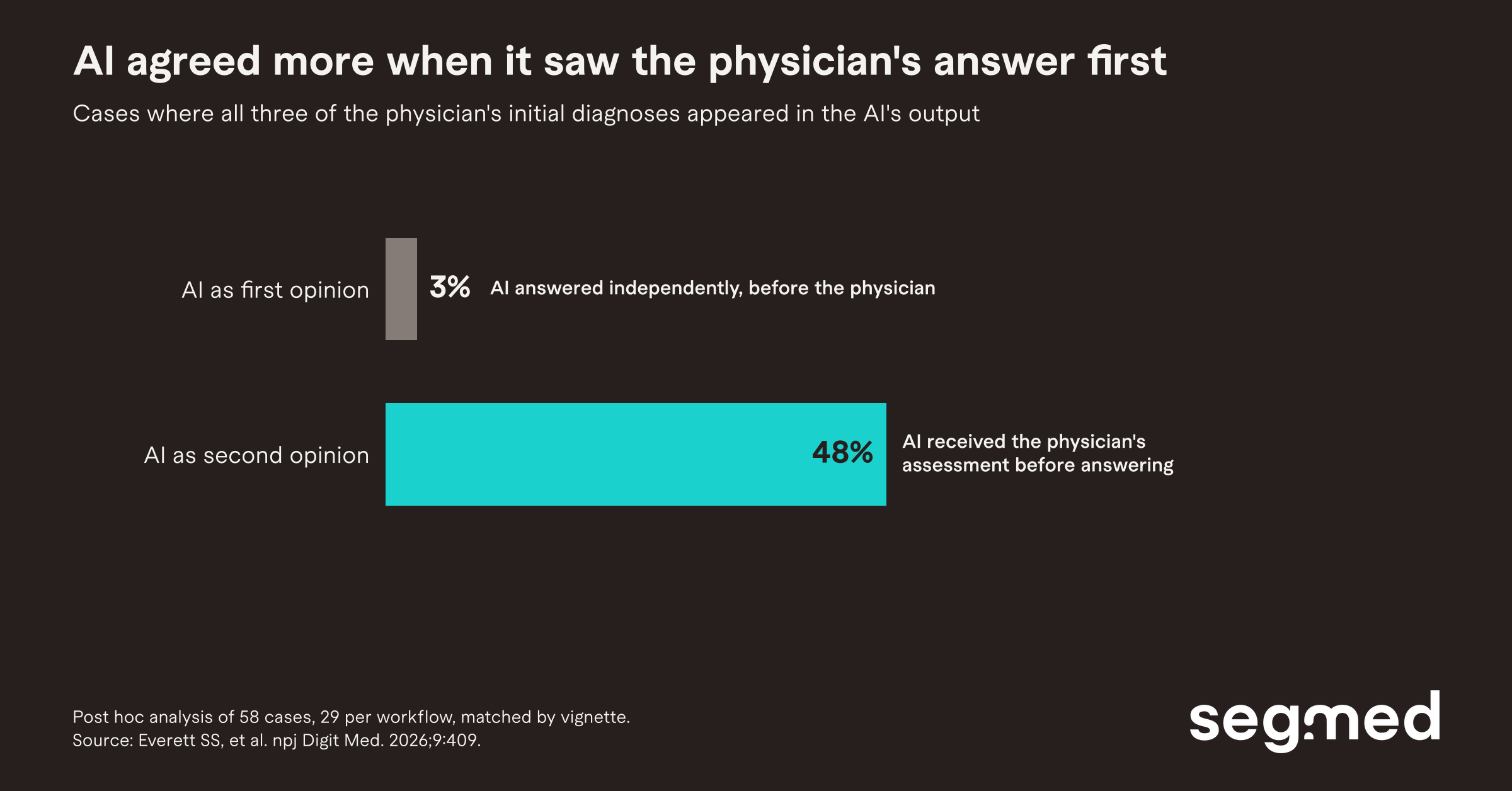
In other words, our AI buddy may sometimes be too eager to agree with us rather than challenge our reasoning.
Evidence snapshot
When AI saw the physician's assessment first, it repeated all three initial diagnoses in 48% of cases. Answering independently, it did so in 3%.1
Table 1 summarizes the trial's key results.
Where Does the Evidence Fall Short?
But there are some concerns. The trial used clinical vignettes rather than real patient encounters. The authors note that vignette-based cases are not representative of real-world clinical practice. Better diagnostic performance in a controlled environment does not necessarily mean better patient outcomes or more efficient clinical workflows.
More importantly, in the second-opinion workflow, clinically actionable scores declined in 8% of cases after clinicians reviewed the AI's input. In plain English, AI assistance sometimes made clinical decisions worse. This is especially concerning given automation bias, in which clinicians may accept AI recommendations uncritically.
This study supports the idea that having an AI assistant could be worthwhile.
The point is that we are all looking for the best way to bring AI tools into clinical practice. A "better together than alone" approach may offer a solution for real-world scenarios. It relies on collaborative interfaces that use the complementary skills of AI systems and clinicians. AI may excel at recognizing patterns across large amounts of data. Clinicians contribute contextual understanding, experience, clinical judgment, and the ability to recognize unusual presentations.
So, there may be an increased cognitive workload. But better strategies and the right skills could make AI integration worthwhile in the long run. Whether these benefits justify the extra time and cognitive effort remains an open question.
Perhaps the question is no longer whether AI can help physicians, but how to make the most of it in clinical practice.
So yes, having an AI buddy may be worth it. But choosing the right buddy is only half the challenge. Learning how to work together may be what really makes the difference.
How Segmed supports clinician-AI collaboration
The trial's own caveat is the gap between vignettes and real patients. Closing it takes evidence from real-world data. Segmed provides de-identified, high-quality real-world data, linked to radiology reports and longitudinal clinical records. AI developers and life sciences teams use it to build and test clinical AI beyond simulated cases.
Building clinical AI that has to hold up beyond the vignette? Book a call with our team.
Frequently Asked Questions – F.A.Q.
What is clinician-AI collaboration in diagnosis?
It is a workflow in which the clinician and the AI each assess a case and then compare their reasoning. In the Everett et al. trial, a custom GPT-4 system highlighted agreements and disagreements and offered commentary.1
Does AI help physicians make better diagnoses?
In this trial, it did on simulated cases. Physicians scored 85% and 82% with the two AI workflows, versus 75% with conventional resources.1
Is it better to see the AI's opinion first or second?
Overall scores were similar.AI as a first opinion did better on clinically actionable decisions, by 8.9 percentage points.
Can an AI assistant simply agree with the physician?
It can. When AI saw the physician's assessment first, it repeated all three initial diagnoses in 48% of cases, versus 3% when it answered independently.
Can AI assistance make clinical decisions worse?
Sometimes. In the second-opinion workflow, clinically actionable scores declined in 8% of cases after clinicians reviewed the AI's input.
Do these results apply to real patients?
Not directly. The trial used clinical vignettes, which the authors note are not representative of real-world clinical practice.
References
1. Everett SS, Bunning BJ, Jain P, Lopez I, Agarwal A, Desai M, et al. From tool to teammate in a randomized controlled trial of clinician-AI collaborative workflows for diagnosis. NPJ Digit Med. 2026;9:409. doi:10.1038/s41746-026-02545-1
Related Resources
Implementing AI as a Teammate in Healthcare
Real-world validation still matters for imaging AI
MedGemma and the Limits of Benchmark Evidence in Imaging AI